
Computer Aided Engineering Design Book In Pdf
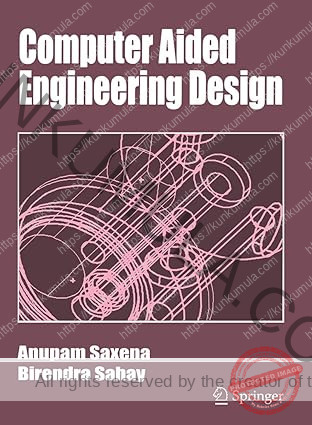
If you’ve ever wondered how engineers turn wild ideas into precise, working designs without losing their minds (or their coffee), then Computer Aided Engineering Design is here to save the day and maybe your GPA too.
Let’s be honest: engineering can sometimes feel like trying to solve a puzzle where half the pieces are invisible and the other half are labeled in symbols you’ve never seen before. This book steps in like that one smart friend who actually explains things in a way that makes sense and throws in a little humor along the way.
A discipline becomes “official” when it gets its own textbook, right? Well, Computer Aided Engineering Design (CAED) has proudly reached that stage and it’s not just showing up, it’s showing off. Even though it’s only a few decades old (basically a teenager in academic years), CAED has already built a reputation as a powerful, ever-growing field.
What makes CAED exciting is that it refuses to stay in one lane. It borrows brilliance from areas like computer graphics, differential geometry, Boolean algebra, numerical analysis, and more. Think of it as the ultimate engineering mashup like a superhero team, but instead of fighting villains, it fights bad design.
And yes, CAED doesn’t work alone. It’s closely connected to Computer Aided Manufacturing (CAM), meaning what you design on a screen can actually become something real in the world. That’s right this is where imagination meets production. It’s basically engineering magic, just with more equations.
Now, if you’ve ever tried reading research papers and felt like you accidentally opened a secret codebook, you’re not alone. The world of CAED is full of scattered information across journals, conference papers, and textbooks that sometimes assume you already know everything (which, let’s face it, most of us don’t).
That’s where this book comes in with a mission. Instead of overwhelming you with flashy graphics and distractions, it focuses on the true backbone of CAED: the mathematics and core principles that actually make everything work. Yes, math but don’t worry, it’s the kind that finally clicks.
This book takes you step-by-step through the fundamental concepts of geometric modeling. In simpler terms, it teaches you how to create smooth surfaces, realistic shapes, and solid models that don’t look like they were drawn by a confused robot on its first day.
But wait, there’s more (yes, like a late-night infomercial, but actually useful). You’ll also explore a wide range of topics including machine design, linkages, finite element analysis, and optimization. Translation? You’ll learn how to design things that not only look good but actually work.
And just when you think it’s all theory, the book brings everything down to earth with real-world applications. Because what’s the point of knowing something if you can’t use it to solve actual problems or impress your lecturer?
Written in a logical and easy-to-follow way (no unnecessary academic gymnastics here), this book is perfect for senior students, graduate learners, and even professionals working with CAD software. Whether you’re learning, building, or debugging your designs at 2 AM, this book has your back.
At the end of the day, Computer Aided Engineering Design isn’t just a textbook, it’s your guide, your coach, and occasionally your comic relief in the complex world of engineering. It helps you think smarter, design better, and maybe even enjoy the process along the way.
So, if you’re ready to turn confusion into clarity, ideas into models, and models into reality, this book is your perfect starting point. Warning may cause sudden bursts of understanding and unexpected confidence.